Why Campus Device Theft Coverage Could Save You Thousands
Campus device theft coverage is insurance that protects your laptop, smartphone, tablet, and other electronics from theft, accidental damage, and other losses while you’re at college.
Here’s a quick breakdown of your main options:
| Coverage Type | Best For | Typical Deductible | Covers Accidental Damage? |
|---|---|---|---|
| Parents’ homeowners policy | Dorm students | $500+ | Rarely |
| Specialized student insurance | All students | As low as $25 | Yes |
| University insurance program | School-owned devices only | $500–$5,000 | Sometimes |
| Renters insurance | Off-campus students | $250–$500 | Rarely |
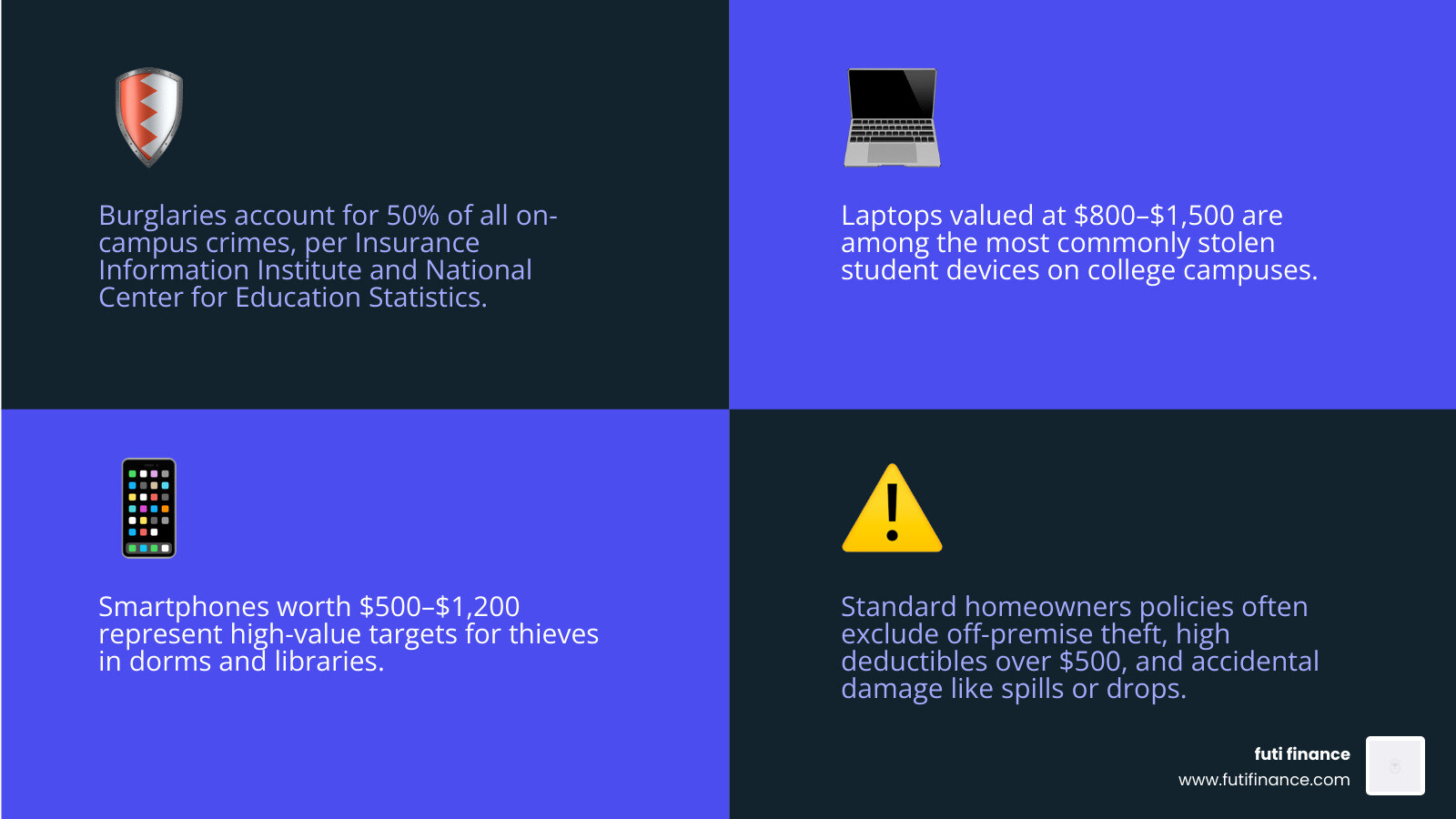
College campuses are busy, open, and full of expensive tech — which makes them a prime target for theft. In fact, burglaries make up roughly 50% of all on-campus crimes, according to data from the Insurance Information Institute and the National Center for Education Statistics.
Think about everything a typical student carries daily:
- A laptop worth $800–$1,500
- A smartphone worth $500–$1,200
- A tablet, earbuds, or gaming device
That’s potentially thousands of dollars of unprotected tech walking around campus every day.
And here’s the problem most students don’t find out until it’s too late: standard homeowners or renters policies often have high deductibles, strict limits on off-campus property, and don’t cover accidental damage like drops or spills at all.
Specialized student insurance fills those gaps — often with deductibles as low as $25 and worldwide coverage.
This guide walks you through everything you need to know to protect your devices on campus.
Understanding the Risks: Why Campus Device Theft Coverage is Essential

It only takes a few seconds. You head to the cafe counter to grab your latte, or you leave your dorm door unlocked for “just a minute” to visit a friend down the hall. When you return, your laptop is gone. This scenario is unfortunately common in 2026.
As we noted, burglaries constitute approximately 50 percent of all on-campus crimes. But why are students such frequent targets? It comes down to the high value and high portability of modern tech. According to Electronic Theft, the portability of laptops and small electronics makes them incredibly susceptible to theft, especially in buildings and offices where foot traffic is high.
The Vulnerability of Specific Devices
Not all devices are targeted equally. Current trends show that iPads are significantly more likely to be stolen than Chromebooks. This is likely due to the higher resale value and brand desirability of Apple products. Whether you are using a high-end MacBook or a versatile tablet, your tech is a “high-liquidity” asset for a thief.
When and Where Theft Happens
Theft isn’t just a nighttime worry. Most dorm thefts actually occur during the day when students are moving between classes. Furthermore, theft rates tend to peak during semester breaks or holiday periods when campus buildings are less populated but still contain valuable equipment.
Beyond just theft, your devices are at risk from your own lifestyle. Did you know that a significant percentage of damage claims occur while a device is inside a bookbag? Whether it’s a heavy textbook crushing a screen or a leaky water bottle, the “safety” of your backpack is often an illusion. In fact, drops and falls account for a massive portion of all insurance claims filed by students.
Comparing Your Options for Campus Device Theft Coverage
When it comes to protecting your gear, you have a few different paths to choose from. Understanding the nuances between them can save you a massive headache (and a lot of money) when a crisis hits.
| Feature | Parents’ Homeowners Policy | Specialized Student Insurance | University Self-Insurance |
|---|---|---|---|
| Primary Goal | Protect the family home | Protect student lifestyle/tech | Protect institutional assets |
| Typical Deductible | $500 – $1,000+ | $25 – $100 | $500 – $5,000 |
| Accidental Damage | Excluded | Included (Spills, Drops) | Limited to school-owned |
| Theft Requirement | Forced entry often required | Any theft covered | Forced entry strictly required |
| Premium Impact | Claims may raise home rates | No impact on home policy | N/A (Departmental) |
As noted by the University of Chicago, many institutional programs are designed for university-owned equipment and often have high deductibles (sometimes 10% of the value) and strict requirements for enrollment. This highlights why personal campus device theft coverage is so vital for students bringing their own gear.
Limitations of Standard Homeowners Policies for Campus Device Theft Coverage
While many parents assume their homeowners insurance has them covered, the reality is often disappointing. Standard policies usually offer “off-premise” coverage, but this is typically limited to a small percentage of the total personal property limit (often 10%).
More importantly, the deductibles are usually much higher than the cost of a single device. If your $800 laptop is stolen and your deductible is $1,000, your insurance provides zero financial help. Additionally, filing a claim for a student’s laptop could cause the entire family’s homeowners premium to spike, costing more in the long run.
Benefits of Dedicated Campus Device Theft Coverage
Specialized policies are built for the “oops” moments of college life. These plans typically cover:
- Liquid Spills: The classic “coffee on the keyboard” moment.
- Cracked Screens: Protection from the dreaded bookbag crush or floor drop.
- Worldwide Protection: Coverage that follows you to a coffee shop, a spring break trip, or a semester abroad.
- Identity Theft: Many specialized plans now include free identity theft protection, which is crucial for young adults building their credit.
Specialized Student Property Insurance: What’s Included?

A comprehensive campus device theft coverage policy does more than just replace a stolen item. It acts as a safety net for almost any disaster that can happen in a dorm or student apartment.
Beyond Theft: Perils Covered
While theft is the headline, student-focused insurance typically covers a wide range of “perils,” including:
- Fire and Smoke: Dorm fires are surprisingly common, often caused by cooking appliances or overloaded power strips.
- Water Damage: This includes everything from a burst pipe in the dorm ceiling to a spilled soda.
- Vandalism: If your property is damaged during a campus protest or a rowdy dorm party, you’re covered.
- Natural Disasters: Coverage often extends to earthquakes, floods, and lightning strikes.
University-Owned vs. Personal Property
It is important to distinguish between what you own and what the school owns. According to MIT’s Office of Insurance, universities often have very strict rules for their own equipment. For example, some institutions will not reimburse for a stolen laptop if it was left unattended or if there were no signs of forced entry.
Fortunately, the best student insurance policies often cover university-owned equipment that is in your care, custody, or control. This is a lifesaver if you lose a high-end lab laptop or a school-issued iPad.
Immediate Steps to Take After a Device is Stolen
If the worst happens, you need to act fast. The steps you take in the first 24 hours can determine whether or not your insurance claim is approved.
- File a Police Report Immediately: Whether the theft happened on or off campus, you need an official case number. As UC Berkeley’s IRIS department points out, you should contact the campus police (UCPD) for on-campus incidents or local police for off-campus ones.
- Remote Lock and Wipe: If you have tracking software like “Find My” or “Prey” installed, use it immediately to lock the device and protect your data. UC Davis IT Services recommends doing this before the thief has a chance to take the device offline.
- Notify the University: If the device was school-owned or contained sensitive university data, you must report it to the school’s IT or risk management office—often within 24 hours.
- Gather Documentation: To file a claim, you will typically need the police report, the original purchase receipt, and the serial number of the device.
- File the Insurance Claim: Contact your insurance provider to start the process. Most specialized student insurers allow you to do this online 24/7.
Prevention and Best Practices for Students
While campus device theft coverage provides a financial safety net, the best-case scenario is never losing your device in the first place. Prevention is about making your tech a “hard target.”
- The “Double-Lock” Rule: Don’t just lock your dorm door. Keep your laptop in a locked drawer or cabinet inside the room. Many university policies, like those at UMD, emphasize that “unexplained disappearances” aren’t covered, but forced entry into a locked space usually is.
- Use Physical Deterrents: A simple Kensington cable lock can prevent a “grab and go” theft in the library.
- Engrave and Track: Engrave your name or student ID on the bottom of your devices. It makes them much harder to resell. Also, ensure that tracking services are enabled and that you know how to log into them from a different device.
- Inventory Everything: Before you move in, take photos of your tech, write down the serial numbers, and save your digital receipts in a cloud folder. This makes the claims process significantly faster.
- Back Up Regularly: Insurance can replace a laptop, but it can’t replace the 20-page term paper you spent three weeks writing. Use cloud storage (Google Drive, iCloud, OneDrive) so your data is always safe.
Frequently Asked Questions about Student Insurance
Does my parents’ homeowners insurance cover my laptop in a dorm?
Yes, usually, but with major catches. Most policies extend 10% of their “Personal Property” limit to students living on campus. However, you will still have to pay the standard deductible, which is often $500 or $1,000. Additionally, homeowners insurance almost never covers accidental damage like a cracked screen or a spilled drink.
When should off-campus students get their own renters insurance?
If you live off-campus, your parents’ homeowners policy likely won’t cover you at all. Many landlords actually require you to have renters insurance as part of the lease. Beyond protecting your stuff, renters insurance provides liability coverage, which protects you if someone is injured at your apartment or if you accidentally cause a fire or flood that damages the building.
Does student insurance cover accidental spills or drops?
Yes! This is the primary reason many students choose specialized campus device theft coverage over standard options. While a standard renters policy only covers “named perils” like fire or theft, student-specific policies are designed for the reality of college life—including the 0 percent of damage claims that occur in bookbags or the frequent drops that result in shattered screens.
Conclusion
Your college years should be spent focusing on your future, not worrying about how you’ll afford to replace a $1,200 laptop after a moment of bad luck. Between high campus burglary rates and the daily risks of spills and drops, having the right protection is simply smart planning.
At Futi Finance, we believe insurance should be as mobile and intelligent as you are. We offer tailored, smart insurance solutions designed specifically for students and young adults. Whether you’re in a dorm, an off-campus apartment, or studying abroad in London, we’ve got your back.
Don’t wait until you’re staring at an empty desk or a cracked screen. Protect your tech with Futi Finance today and get the peace of mind you need to succeed.
