
How to Protect Your Dorm Room for the Price of a Pizza
Your First Apartment Shouldn’t Come With a Financial Blind Spot
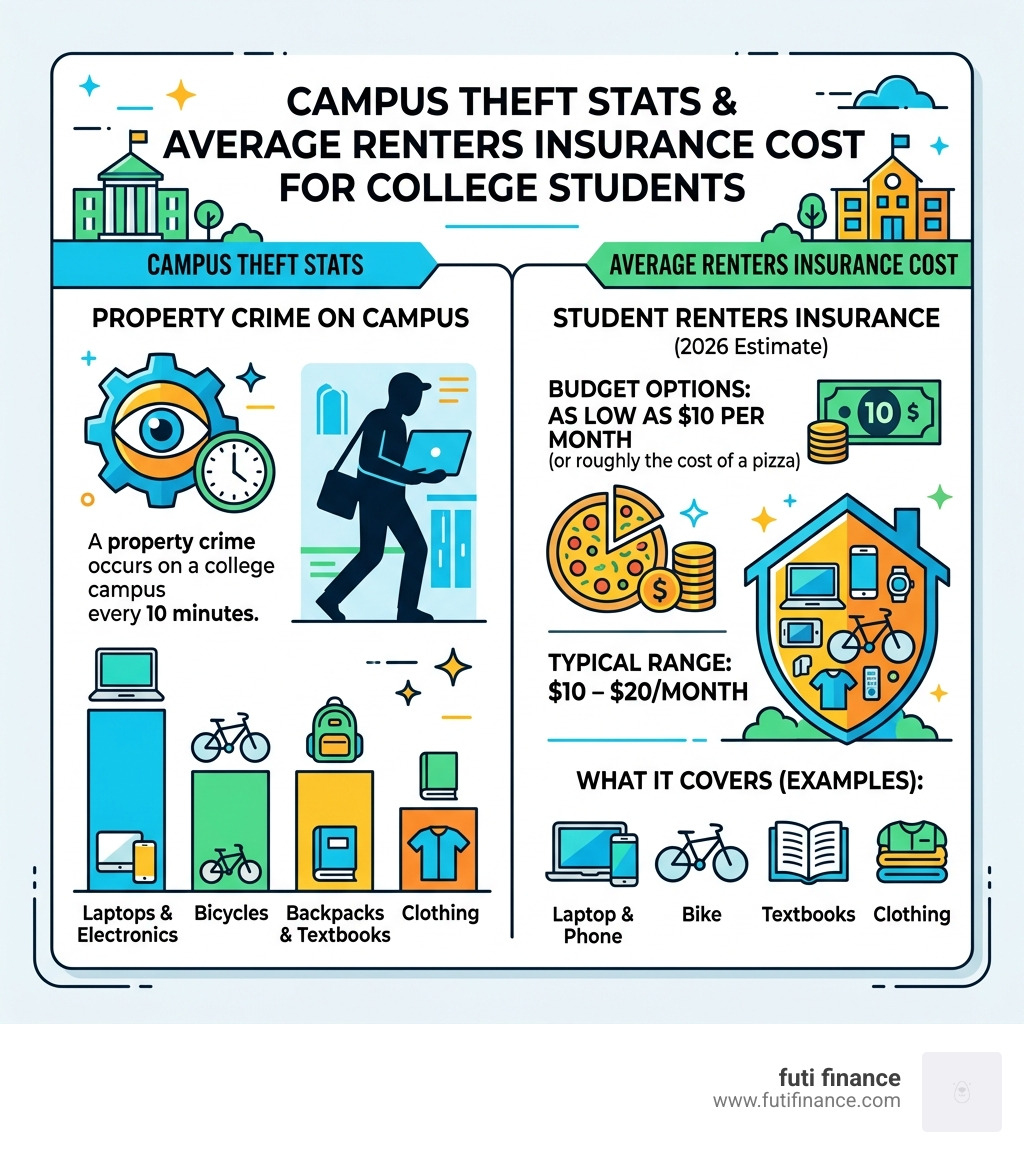
Budget renter insurance college students can actually afford starts at around $10 per month — roughly the cost of a pizza — and covers your laptop, bike, phone, and more against theft, fire, and accidental damage.
Here’s a quick answer to what you need to know:
| What You Want to Know | Quick Answer |
|---|---|
| Average monthly cost | $10–$20/month |
| What it covers | Laptop, phone, bike, clothes, liability |
| Do dorm students need it? | Maybe — parents’ policy may cover up to 10% of their limit |
| Do off-campus students need it? | Yes — most landlords require it |
| Do roommates share a policy? | No — each person needs their own |
| Cheapest option | As low as $5–$10/month |
Moving into a dorm or your first apartment is exciting. But here’s something most students don’t think about until it’s too late: nobody is automatically protecting your stuff.
Your landlord’s insurance covers the building. Not your laptop. Not your phone. Not your bike.
And your parents’ homeowners policy? It might help a little — but usually only up to 10% of their total coverage limit, and often not at all once you sign an off-campus lease.
That means if your $1,200 laptop disappears during a dorm break-in — which happens more than you’d think, given that a property crime occurs on a college campus every 10 minutes — you could be paying out of pocket to replace it.
Renters insurance changes that. For less than you spend on takeout each month, you can protect everything you brought to campus.
Why College Students Need Renters Insurance
College is often the first time we experience true independence. We pack up our lives—laptops, gaming consoles, bikes, and those expensive textbooks—and head to a new environment. But campuses are high-traffic areas, and that makes them prime targets for property crime.

The Harsh Reality of Campus Crime
In April 2026, the statistics remain sobering. Research shows that approximately 28% of all on-campus crimes are related to theft and burglary. With a property crime occurring every 10 minutes on American campuses, the “it won’t happen to me” mentality is a dangerous financial blind spot. In a single year, there have been over 17,500 reported burglaries in on-campus housing facilities.
Beyond Theft: Fire and Water Damage
It isn’t just about someone walking off with your backpack. Accidents happen. Maybe a neighbor in the dorms forgets to put water in their instant mac-and-cheese and leaves it in the microwave for 20 minutes, triggering the sprinkler system. Or perhaps a pipe bursts during winter break while you’re away.
Without budget renter insurance college coverage, you are responsible for replacing your own ruined electronics and furniture. According to the Renters Insurance for College Students – National Insurance Guide, a typical student’s assets—including a laptop (~$1,200), smartphone (~$500), bike (~$300), and textbooks (which can easily top $500)—often total over $3,000. Replacing that on a student budget is nearly impossible without help.
Liability: The “Oops” Protection
Renters insurance also provides liability protection. If a guest trips over a rug in your room and breaks their arm, or if you accidentally cause a small kitchen fire that damages the building, you could be held financially responsible. Liability coverage steps in to pay for medical bills or legal fees so a single accident doesn’t derail your entire education.
Budget Renter Insurance College: Dorms vs. Off-Campus Housing
Where you live changes your insurance needs. We often see students assume they are covered by their parents’ policies, but the fine print can be tricky.
The Dorm Dilemma
If you live in a campus-owned dorm, you might be covered under your parents’ homeowners insurance as a “legal resident” of their home. However, this coverage is usually limited. Most policies only extend about 10% of their personal property limit to “off-premises” locations. If your parents have $100,000 in coverage, you only have $10,000 for your dorm. Furthermore, homeowners’ deductibles are often high—between $1,000 and $2,500. If your $800 laptop is stolen, a policy with a $1,000 deductible literally pays you nothing.
Off-Campus Reality
Once you sign a lease for an apartment or house off-campus, most parental homeowners policies stop covering you entirely. At this point, you are a tenant with your own legal contract, and you need your own policy.
Housing Types That Usually Require Insurance:
- Off-campus apartments managed by property firms.
- Rented houses or townhomes.
- Certain university-affiliated luxury student housing.
- Greek life housing (Fraternities/Sororities).
Is Budget Renter Insurance College Required for Off-Campus Leases?
In 2026, it is almost a guarantee that an off-campus landlord will require proof of renters insurance before handing over the keys. Landlords want to ensure that if you accidentally damage the unit (like causing a water leak), your insurance will cover the repairs. Most leases require a minimum of $100,000 in liability coverage. Providing a “Certificate of Insurance” naming the landlord as an interested party is a standard part of the modern move-in process.
What Does a Student Policy Actually Cover?
When we talk about budget renter insurance college plans, we’re looking at four main pillars of protection.
- Personal Property: Protection for your “stuff” (electronics, clothes, furniture) against perils like theft, fire, smoke, and vandalism.
- Liability Coverage: Protection if you are sued for accidentally injuring someone or damaging property that isn’t yours.
- Loss of Use (Additional Living Expenses): If a fire or burst pipe makes your apartment unlivable, this pays for a hotel and extra meal costs while repairs are made.
- Medical Payments: Covers small medical bills for guests injured in your home, regardless of who is at fault.
Actual Cash Value vs. Replacement Cost Value
This is the most important choice you’ll make when picking a policy. We always recommend choosing Replacement Cost Value (RCV) for students.
| Feature | Actual Cash Value (ACV) | Replacement Cost Value (RCV) |
|---|---|---|
| Definition | Pays what the item is worth today (depreciated). | Pays what it costs to buy a new version today. |
| Example | Your 3-year-old laptop is stolen. You get $300. | Your 3-year-old laptop is stolen. You get $1,200 for a new one. |
| Cost | Slightly cheaper monthly premium. | Slightly higher, but much better protection. |
| Verdict | Not recommended for tech-heavy students. | The Gold Standard for college life. |
Finding the Best Budget Renter Insurance College Policy
To keep costs low while maintaining high protection, consider these strategies:
- Deductible Selection: A $500 deductible is standard. Choosing a $1,000 deductible will lower your monthly premium, but make sure you actually have $1,000 in savings in case you need to file a claim.
- Bundling: If you have your own auto insurance, bundling it with renters insurance can save you up to 20% on your premiums.
- Safety Discounts: Many providers offer discounts if your building has smoke detectors, fire extinguishers, or 24/7 security/doormen.
- Electronic Riders: If you have a high-end gaming PC or expensive musical instruments, you can “schedule” these items to ensure they are covered for their full value without a deductible.
Frequently Asked Questions about Budget Renter Insurance College
Do I need my own policy if I have roommates?
Yes. A common myth is that one policy covers the whole apartment. In reality, renters insurance policies are typically per-person. Unless you are related (like siblings) or specifically co-named on a policy (which many insurers don’t allow for roommates), your policy will only cover your belongings. If your roommate’s laptop is stolen and they don’t have insurance, your policy won’t help them.
How much does renters insurance cost for a student in 2026?
The national average is roughly $14 to $16 per month. However, for a standard student limit of $15,000 in property coverage and $100,000 in liability, we see many students paying as little as $10 per month. That truly is the price of a large pizza or two fancy coffee runs. It is one of the few “adulting” expenses that actually fits into a tight budget.
Does renters insurance cover my laptop if it’s stolen at the library?
Yes! This is one of the best “hidden” features of renters insurance. Most policies include off-premises coverage. This means your belongings are protected anywhere in the world. If your phone is swiped while you’re studying in the library, or your suitcase is stolen during spring break in Mexico, your renters insurance can reimburse you for the loss.
Conclusion
At Futi Finance, we believe that being a student is hard enough without having to worry about the financial ruin of a stolen laptop or an accidental kitchen fire. Protecting your college life doesn’t have to be expensive or complicated.
By choosing a budget renter insurance college plan, you’re not just buying a piece of paper; you’re buying the peace of mind to focus on your finals instead of your finances. Before you head to campus, take ten minutes to inventory your belongings—take a quick video of your room and save digital receipts for your big-ticket items.
Ready to secure your future? Protect your college life with Futi Finance and get the smart, affordable coverage you deserve. Don’t let a single bad day derail your entire semester—get covered today for the price of a pizza.
