
A Complete Guide to Health Insurance for the Young and Invincible
Why Young Adult Health Cover Is More Important Than You Think
Young adult health cover refers to the health insurance options available to people roughly between the ages of 18 and 30 — and choosing the right one can be the difference between financial security and a bill that wipes out your savings.
Here’s a quick overview of your main options:
| Coverage Option | Who It’s For | Key Benefit |
|---|---|---|
| Parent’s health plan | Under 26 | Often free or low-cost to join |
| Employer-sponsored plan | Working young adults | Employer pays part of premium |
| ACA Marketplace plan | Most young adults | Subsidies available based on income |
| Medicaid | Income at or below ~$21,597/year | Free or very low cost |
| Student health plan | Enrolled college students | Convenient, meets ACA requirements |
| Catastrophic plan | Under 30 | Low premiums, emergency protection |
| TRICARE Young Adult | Military family dependents (21–26) | Comprehensive military coverage |
Most young adults feel invincible. Doctor visits feel optional. Insurance feels like an unnecessary monthly expense.
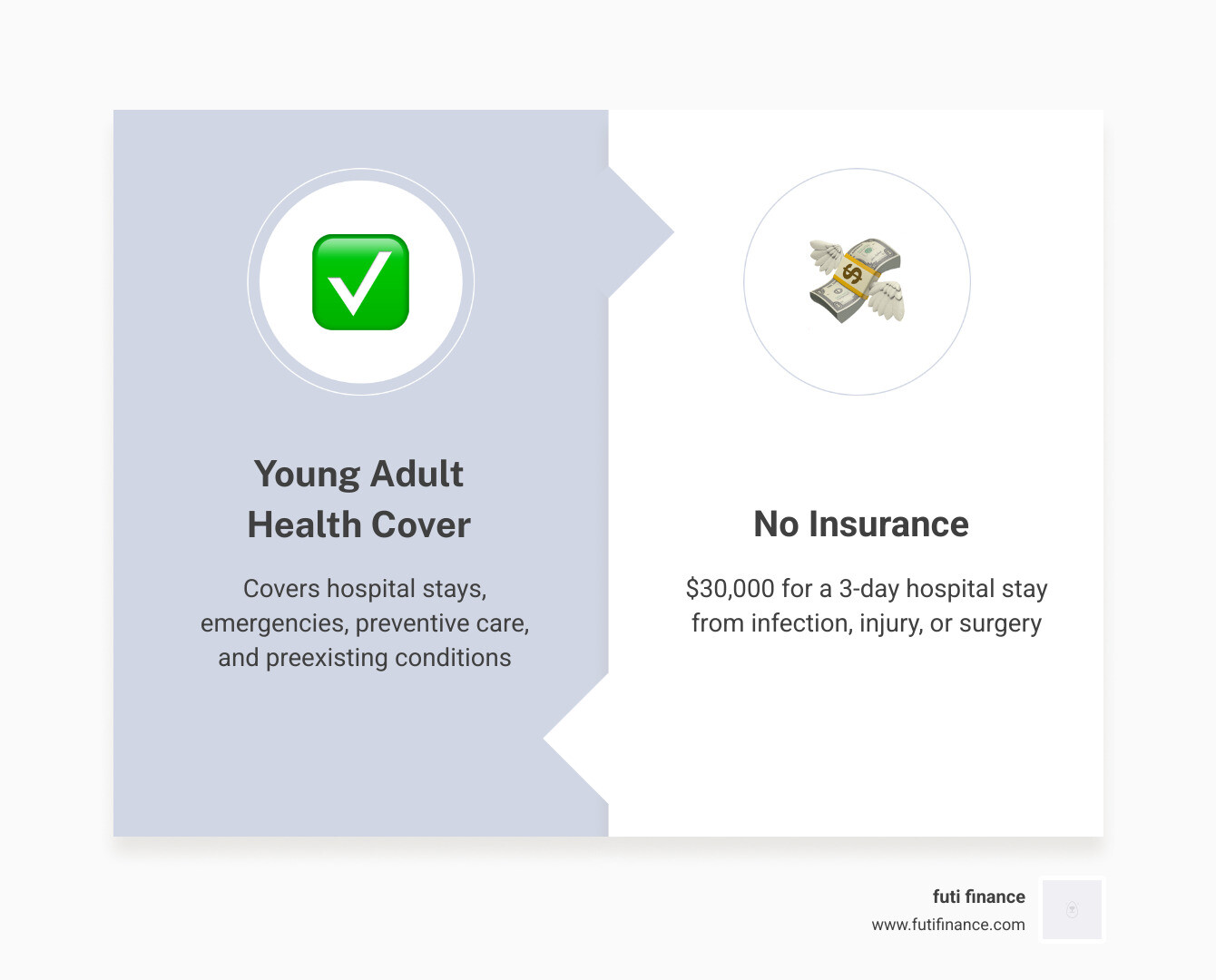
But consider this: a single 3-day hospital stay can cost $30,000 without coverage. That’s not a rare worst-case scenario — it’s a realistic outcome from something as common as a bad infection, a broken bone, or an unexpected surgery.
Health insurance isn’t just for people who are sick. It’s a financial safety net for people who aren’t — until suddenly they are.
This guide breaks down every major young adult health coverage option in plain language, so you can find the plan that fits your life, your budget, and your health needs.
Understanding Your Options for Young Adult Health Cover
When we talk about young adult health cover, it’s not a one-size-fits-all situation. Depending on where you are in life—finishing college, starting your first “real” job, or freelancing your way through your 20s—your best option will shift.

Parental Plans: The Gold Standard for Under-26s
Since 2010, the Affordable Care Act (ACA) has allowed young adults to stay on their parents’ health insurance plan until they turn 26. This is often the most affordable route. One of the biggest myths we hear is that you lose this right if you get married, move out, or get a job. That’s simply not true. You can remain on your parent’s plan regardless of your marital status, whether you live in their basement or across the country, or even if you have access to insurance through your own employer.
Employer-Sponsored Insurance
If you’ve landed a job that offers benefits, this is usually your next best bet. Employers typically pay a significant portion of the monthly premium, making it cheaper than buying a plan on your own. These plans often come with a “formulary” (a list of covered drugs) and a network of doctors you’ll need to stick to.
The ACA Marketplace
If you don’t have a job that offers benefits and you’re over 26, the Marketplace is where you’ll go. These plans are regulated to ensure they cover “essential health benefits,” which include:
- Preventive services (like flu shots and screenings) at no extra cost.
- Mental health and behavioral health services.
- Prescription drugs.
- Maternity and newborn care.
Importantly, you cannot be denied coverage or charged more because of a preexisting condition. You can explore these options further at Health Care Coverage Options for Young Adults | HealthCare.gov.
Medicaid Eligibility
For those of us just starting out and earning a lower income, Medicaid is a lifesaver. As of April 2026, if your annual income is $21,597 or less (which is 138% of the federal poverty level for a single adult), you may qualify for free or very low-cost coverage. In states that have expanded Medicaid, this eligibility is based purely on your income, making it much easier to get covered while you’re building your career.
Navigating the Transition to Independent Young Adult Health Cover
The “Age 26 Milestone” is a significant event in the insurance world. It’s often referred to as “aging out.” When you turn 26, you generally lose the ability to stay on your parents’ plan at the end of your birth month (though some plans allow you to stay until the end of the calendar year).
The Special Enrollment Period (SEP) Normally, you can only sign up for health insurance during the Open Enrollment Period (usually November 1 to January 15). However, losing your parental coverage when you turn 26 is considered a “qualifying life event.” This triggers a 60-day Special Enrollment Period. This means you don’t have to wait until November to get a new plan; you can—and should—shop for a private individual plan or an employer plan immediately to avoid a coverage gap.
Understanding Policy Variations and Eligibility
Not all young adult health cover is created equal. Depending on where you live, you might find state-specific programs. For instance, in Massachusetts, programs like MassHealth or ConnectorCare provide tailored support for residents.
If you come from a military family, the rules are slightly different. TRICARE Young Adult (TYA) is a plan that qualified adult children can purchase after regular TRICARE eligibility ends at age 21 (or 23 if you are a full-time student and your sponsor provides more than 50% of your financial support). TYA eligibility ends when you turn 26 or get married.
At Futi Finance, we know that comparing these numbers can feel like doing advanced calculus. We simplify the selection process by tailoring smart insurance solutions specifically for the unique needs of students and young professionals. We focus on the “why” and “how much,” so you don’t have to get lost in the fine print.
Specialized Plans: Students and Catastrophic Coverage
For many of us, the first taste of independent insurance comes through a university.

Student Health Plans
Most colleges require you to have health insurance to enroll. Many offer their own student health plans. These are often quite convenient because the clinics are right on campus, and the premiums are usually bundled into your tuition. These plans meet the ACA requirements for “minimum essential coverage,” meaning they provide the same basic protections as Marketplace plans.
Catastrophic Plans: The “Just in Case” Option
If you are under 30, you have a unique option: the Catastrophic Plan. These plans are designed for people who are generally healthy and only want protection against a massive medical bill—like that $30,000 hospital stay we mentioned earlier.
- The Pros: Very low monthly premiums.
- The Cons: Very high deductibles. You will pay for almost all your healthcare out-of-pocket until you hit your deductible (which can be several thousand dollars).
- The Catch: You cannot use premium tax credits (subsidies) to pay for a catastrophic plan. If your income is low enough to qualify for a subsidy, a “Bronze” or “Silver” Marketplace plan will almost always be a better deal.
Choosing the Right Student or Young Adult Health Cover
When evaluating these specialized plans, we recommend looking at your lifestyle. Do you travel out-of-state often? A student plan might have a very restricted network that only works near campus. Are you a freelancer? A catastrophic plan might give you peace of mind, but if you have a chronic condition that requires regular medication, the high deductible might make it more expensive in the long run than a standard plan.
Financial Strategies: Subsidies, Taxes, and Cost-Sharing
The biggest hurdle to getting young adult health cover is usually the price tag. However, the government provides several ways to lower that cost based on your 2026 income.
Premium Tax Credits and Subsidies
If you buy a plan through the Marketplace, you might qualify for a “Premium Tax Credit.” This is a subsidy that lowers your monthly bill. In 2026, if your expected income is at least $15,650, you are likely eligible.
Furthermore, if your income falls between $15,560 and $39,125, you might qualify for “Cost-Sharing Reductions.” These are extra savings that lower your deductible, copayments, and coinsurance—but only if you choose a Silver-level plan.
High-Deductible vs. Low-Deductible Plans
Choosing between these is a balancing act.
| Feature | High-Deductible Plan (HDHP) | Low-Deductible Plan |
|---|---|---|
| Monthly Premium | Lower | Higher |
| Deductible | Higher (e.g., $3,000+) | Lower (e.g., $500 – $1,500) |
| Best For | Healthy people who rarely see a doctor | People with chronic issues or frequent visits |
| HSA Eligible? | Yes | Usually No |
Expert Tip: If you choose an HDHP, we highly recommend opening a Health Savings Account (HSA). This allows you to set aside pre-tax money to pay for medical expenses, which effectively gives you a discount on your healthcare costs.
Key Factors to Evaluate Before Enrolling
Before you hit “Enroll,” take a breath and look at these four critical factors. Don’t just pick the plan with the prettiest logo or the lowest premium.
1. The Network (HMO vs. PPO)
- HMO (Health Maintenance Organization): Usually cheaper, but you must stay within the network and you usually need a referral from a primary care doctor to see a specialist.
- PPO (Preferred Provider Organization): More expensive, but you have more flexibility to see doctors outside the network and you don’t need referrals.
2. The Prescription Formulary
If you take a specific medication, check the plan’s “formulary.” This is a list of drugs the plan covers. Some plans might put your medication in a “Tier 3” or “Tier 4” category, meaning you’ll pay a lot more for it.
3. Mental and Behavioral Health
In our experience, this is often overlooked. Ensure the plan has a robust network of therapists and counselors. Under the ACA, mental health services are an essential benefit, but the quality of the network varies wildly between insurers.
4. Telehealth Access
In 2026, being able to see a doctor via your phone is a must. Many modern young adult health cover options include $0 telehealth visits. This can save you a $50 copay and a two-hour wait in a physical office.
Frequently Asked Questions about Young Adult Insurance
Can I stay on my parents’ plan if I am married or living independently?
Yes! As we mentioned earlier, the ACA rules are very generous. Your marital status, tax dependency, and living situation do not affect your eligibility to stay on your parents’ plan until you turn 26. Your parents just need to keep you on their policy.
What happens if I miss the Open Enrollment Period?
If you miss the January 15 deadline, you usually can’t buy a Marketplace plan until the next year unless you have a qualifying life event. Turning 26, losing your job, getting married, or moving to a new state all trigger a Special Enrollment Period. If you don’t have a qualifying event, you might have to look at “short-term health insurance.” These plans can bridge the gap for a few months, but be careful—they often don’t cover preexisting conditions or essential benefits like maternity care.
How do I qualify for $0 or low-cost monthly premiums?
There are two main ways:
- Medicaid: If you earn roughly $21,597 or less in 2026, you may qualify for Medicaid, which often has a $0 premium.
- Tax Credits: If you earn more than the Medicaid limit but still have a modest income, the government may provide tax credits that cover nearly the entire cost of a Bronze or Silver plan.
Conclusion
Navigating young adult health cover doesn’t have to feel like a chore. While it’s tempting to think of yourself as “invincible,” the reality is that health insurance is less about planning for sickness and more about protecting your future. Whether you are staying on a parent’s plan, exploring the Marketplace, or utilizing a student health plan, the goal is the same: ensuring that a medical emergency doesn’t become a financial disaster.
At Futi Finance, we specialize in providing affordable and intelligent insurance solutions tailored specifically for students and young adults. We believe that getting covered should be simple, smart, and suited to your lifestyle.
Don’t leave your financial health to chance. Take a moment to review your options, check your eligibility for subsidies, and choose a plan that gives you the peace of mind to keep being invincible.
