
The Ultimate Guide to Stolen Bicycle Insurance and Peace of Mind
Stolen Bicycle Insurance: What Every Cyclist Needs to Know
Stolen bicycle insurance can be the difference between replacing your ride and being stuck without one — and more cyclists need it than you’d think.
Here’s the quick answer on how to get covered:
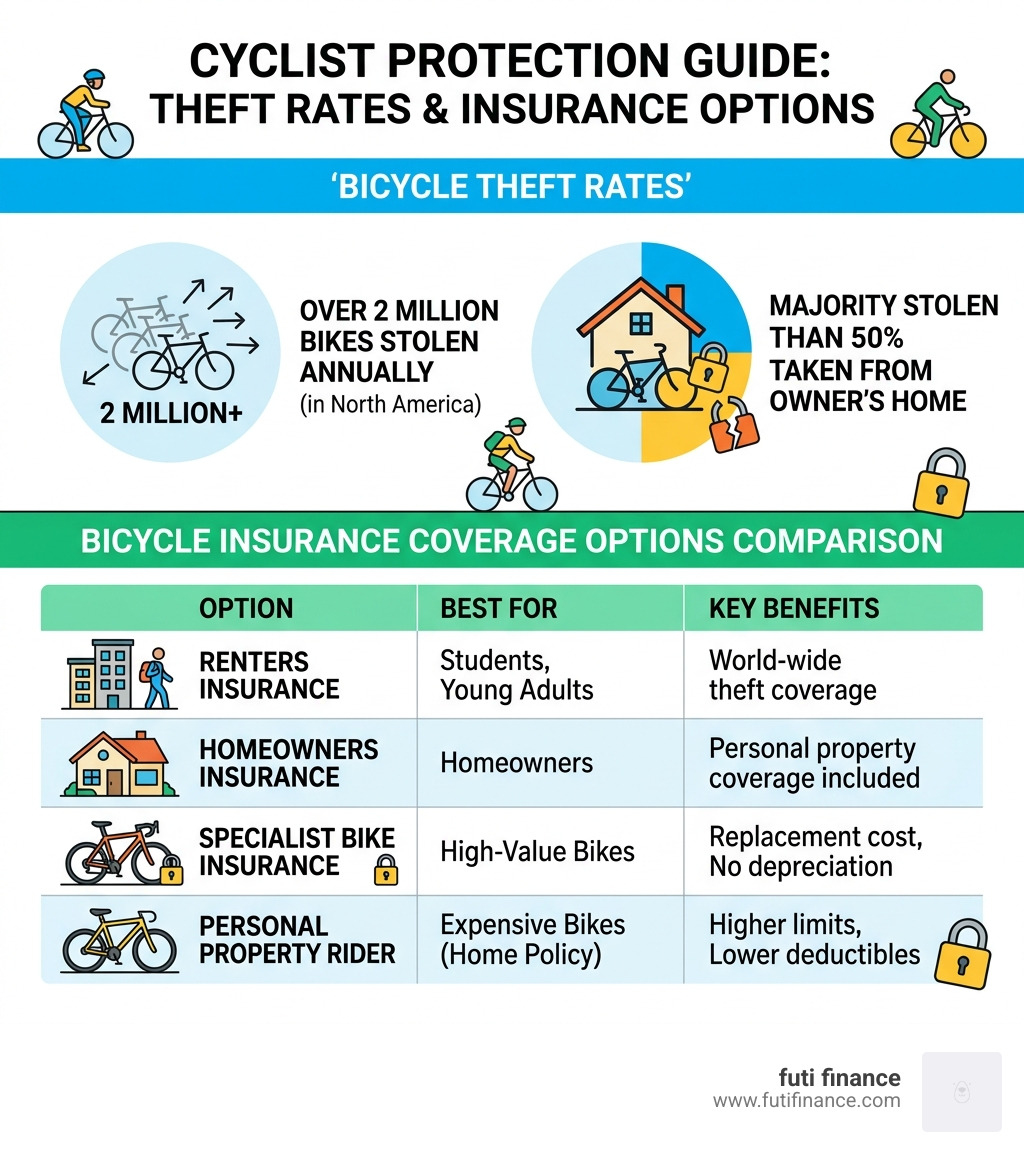
| Option | Best For | Avg. Cost | Key Benefit |
|---|---|---|---|
| Renters insurance | Students, young adults | ~$14/mo | Covers bike theft anywhere in the world |
| Homeowners/condo insurance | Homeowners | Varies | Personal property coverage included |
| Specialist bike insurance | High-value bikes | ~$25/mo | Replacement cost, no depreciation |
| Scheduled personal property rider | Expensive bikes on home policy | Small add-on fee | Higher limits, lower deductibles |
Over two million bikes are stolen every year in North America. Up to half of all cyclists will lose a bike to theft at some point. And here’s the part that stings most: more than 50% of those bikes are taken from the owner’s home, not a sketchy back alley.
For students and young adults, a stolen bike isn’t just frustrating — it can mean losing your main way to get to class or work, and facing a replacement bill you weren’t prepared for.
The good news? You may already have some coverage through a renters or homeowners policy. The catch? It’s often not enough — especially if your bike is worth more than a few hundred dollars.
This guide breaks down exactly what’s covered, what isn’t, and how to make sure you’re not left out of pocket when the worst happens.
Does Your Current Policy Cover a Stolen Bicycle?
Many of us at Futi Finance have been there: you walk out of the library or your apartment, and all that’s left is a snipped cable lock. Your first thought (after a few choice words) is usually, “Am I covered?”
The answer is often found in your personal property coverage. This is a standard component of renters, homeowners, and condo insurance policies.
Renters, Homeowners, and Condo Insurance
If you have a renters policy—which many students and young adults do because it’s so affordable (often around $14 a month)—your bicycle is considered part of your personal property. This means it is protected against “named perils,” which is insurance-speak for a list of 16 specific bad things that can happen, including fire, vandalism, and, most importantly, theft.
One of the best-kept secrets of renters and homeowners insurance is off-premises coverage. Most people assume their policy only works if the bike is snatched from their living room. In reality, these policies typically cover your belongings anywhere in the world. If your bike is stolen from a rack outside a coffee shop or while you’re traveling, your policy likely still applies.
Exclusions and the “Negligence” Trap
However, it isn’t a blank check. Insurance is designed to cover sudden and accidental losses, not poor choices. If you leave your bike unlocked and leaning against a wall in a busy city center, an insurer might deny the claim based on negligence. Similarly, standard policies often have “sub-limits” for bicycles. While your total property limit might be $20,000, the policy might only pay out a maximum of $500 or $1,000 for a single bicycle unless you’ve specifically added Comprehensive Coverage Options.
It’s also worth noting that car insurance almost never covers a stolen bike, even if it was taken off your car’s roof rack or out of the trunk. For that, you must look to your property insurance.
The Financials: Deductibles and Replacement Value
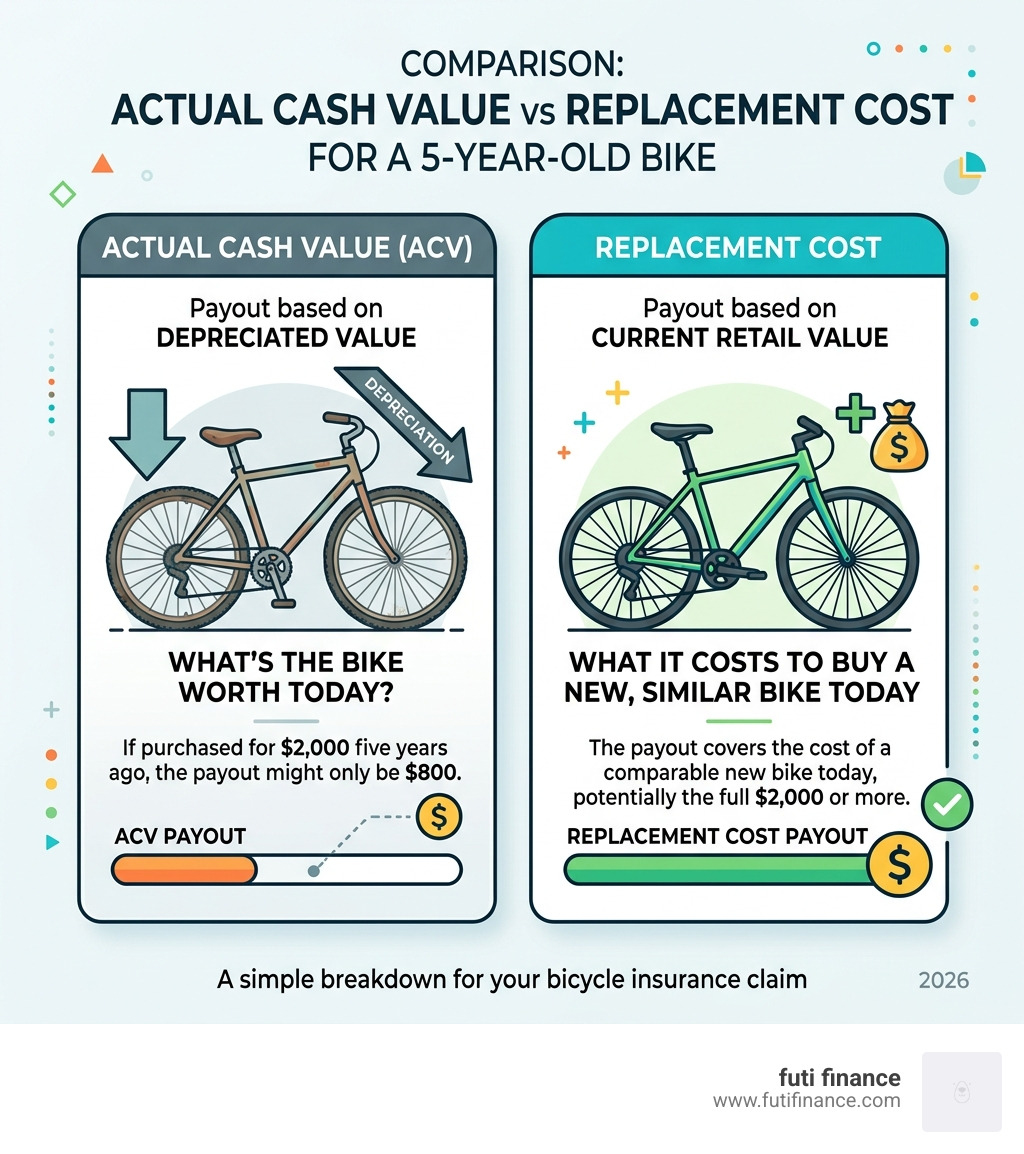
Understanding the math behind a claim is the only way to avoid a “payout letdown.” There are two main ways insurance companies calculate what they owe you: Actual Cash Value (ACV) and Replacement Cost.
Actual Cash Value vs. Replacement Cost
- Actual Cash Value (ACV): This is the depreciated value of your bike. If you bought a mountain bike for $2,000 five years ago, the insurance company might decide it’s now only worth $800. They pay you the $800 minus your deductible.
- Replacement Cost: This is the gold standard. It pays you what it would actually cost to buy the same bike (or a substantially identical one) today, regardless of how old your old one was.
The Role of Deductibles
Your deductible is the amount you pay out of pocket before the insurance kicks in. Standard homeowners deductibles are often high—between $500 and $2,000. If your bike is worth $800 and your deductible is $1,000, your insurance won’t pay a cent.
For students and young adults with high-value gear, we often recommend “scheduling” the bike. This is an insurance rider or endorsement. By scheduling your bike as “scheduled personal property,” you can often get a $0 deductible for that specific item and ensure you’re covered for its full appraised value.
When to Choose Specialist Stolen Bicycle Insurance
Sometimes, a standard renters policy just doesn’t cut it. If you’re riding a $5,000 carbon fiber road bike or a high-end e-bike, specialist stolen bicycle insurance might be the smarter move.
Why Go Specialist?
Specialist providers offer policies designed by cyclists for cyclists. Here is why people choose them over a standard home policy:
- No Premium Hikes: Filing a claim on your homeowners insurance can cause your entire home premium to skyrocket. A standalone bike policy keeps those risks separate.
- Accidental Damage: Most home policies only cover theft or fire. If you crash your bike during a race or accidentally drive your car into the garage with the bike still on the roof, a specialist policy will often cover the repairs.
- Transit and Racing: If you participate in organized races or ship your bike across the country for events, specialist Specialized Theft Protection ensures you’re covered during transit and competition—scenarios standard policies often exclude.
- Accessory Coverage: High-end lights, GPS computers, and even custom wheelsets can add thousands to a bike’s value. Specialist policies often include these items in the total replacement value.
Coverage for E-Bikes and High-Value Equipment
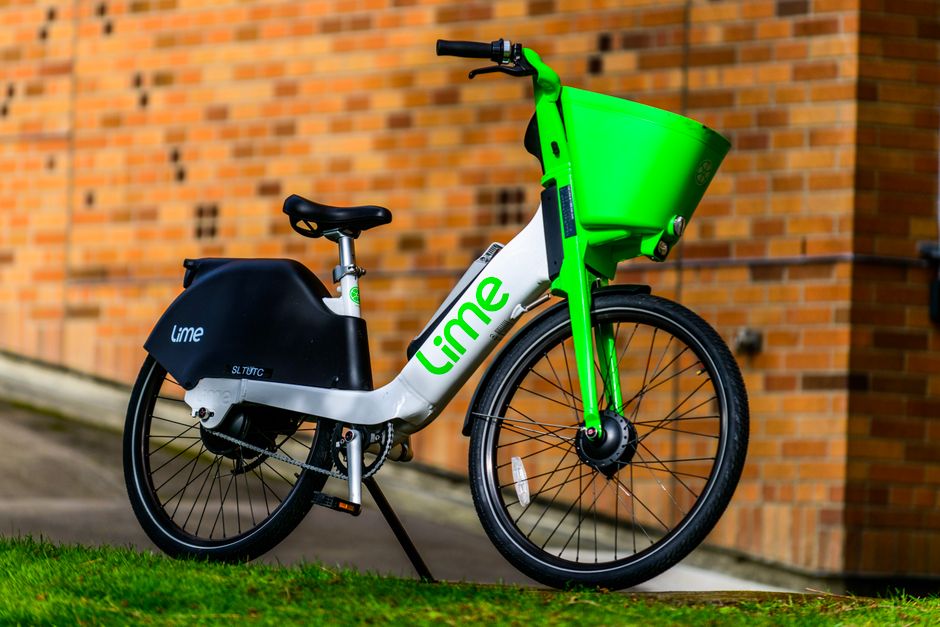
E-bikes are changing the way we commute, but they’ve also created a massive grey area in the insurance world. Because they have motors, many traditional homeowners policies classify them as “motorized vehicles”—the same category as motorcycles or cars—which are explicitly excluded from personal property coverage.
Understanding e-bike classes for stolen bicycle insurance
To know if you’re covered, you need to know your e-bike’s “Class.” Most insurers use the following standards:
- Class 1: Pedal-assist only, no throttle, max speed 20 mph.
- Class 2: Throttle-assisted, max speed 20 mph.
- Class 3: Pedal-assist only, no throttle, max assisted speed 28 mph.
Generally, Class 1 and Class 3 e-bikes are more likely to be covered under standard policies because they require pedaling to move. However, many insurers draw the line at 750 watts. If your motor is more powerful than that, or if it has a throttle (Class 2), you almost certainly need a specialized e-bike rider or a standalone policy.
Battery theft is another specific risk. E-bike batteries are expensive and easy to steal. Specialist policies often cover the battery specifically, whereas a standard policy might require the entire bike to be stolen to trigger a payout.
Filing a Successful Claim: A Step-by-Step Guide
If the worst happens and your bike is gone, your ability to get a payout depends entirely on the “paper trail” you created before the theft.

Step 1: File a Police Report
You cannot file an insurance claim without a police report. Call the non-emergency line immediately. You will need the incident number, the officer’s name, and a copy of the report. Be sure to mention if the bike was registered with a database.
Step 2: Gather Your Evidence
Insurers need proof that you owned the bike and proof of what it was worth. You should have:
- The serial number (usually found under the bottom bracket).
- The original sales receipt (digital copies are best).
- Photos of the bike, including any upgrades or accessories.
- Photos of the “crime scene,” such as a cut lock or a broken garage door.
Step 3: Use Recovery Databases
Registering your bike with Bike Index, 529 Garage, or the National Bike Registry doesn’t just help the police; it proves to the insurance company that you took proactive steps to protect your property. If a bike is recovered after you’ve been paid, the insurance company usually takes ownership of the bike, but they may give you the option to “buy it back” using your payout.
Frequently Asked Questions
How long does a claim take for stolen bicycle insurance?
Most claims are processed within a few weeks, but it can take longer if the documentation is incomplete. State laws generally require insurers to settle claims within a “reasonable timeframe,” which is usually 30 to 60 days. Using an app-based insurer can sometimes speed this up to just a few days.
Does insurance cover theft from a vehicle?
Your car insurance will cover the damage to the car (like a smashed window), but it won’t cover the bike. Your renters or homeowners insurance will cover the bike under “off-premises” personal property coverage. Just make sure the vehicle was locked; many policies exclude theft from unsecured vehicles.
Is it worth filing a claim for a low-value bike?
Probably not. If your bike is worth $300 and your deductible is $500, there is no claim to be made. Even if the bike is worth $600, receiving a $100 payout might not be worth the risk of your insurance premiums increasing at renewal time. In these cases, “self-insurance” (saving up a small emergency fund) is often the better strategy.
Conclusion
At Futi Finance, we know that for a student or a young professional, a bike is more than just a toy—it’s your freedom and your transport. Dealing with a stolen bike is stressful enough without realizing your insurance policy has a loophole the size of a truck.
Whether you choose to stick with a reliable renters policy or upgrade to a specialist plan for your high-end gear, the key is to be proactive. Document your serial number, keep your receipts, and make sure your coverage limits actually match the price tag of a new ride.
Protect your gear and your peace of mind. For more tips on smart insurance solutions tailored for your lifestyle, we’re here to help you navigate protection without the headache. Stay safe and keep riding!
