
Don’t Let the Kids Win: Why You Should Insure My TV
Your TV Is One Accident Away From a Costly Repair Bill
If you want to insure my tv, here’s the short answer:
TV insurance is a protection plan that covers your television against accidental damage, electrical breakdowns, and mechanical faults — often for as little as a few dollars or pounds per month. It fills the gaps that manufacturer warranties and standard home insurance leave behind.
Quick answers for common situations:
| Situation | Is TV insurance right for you? |
|---|---|
| You have kids or pets at home | Yes — high accident risk |
| Your TV costs $500 or more | Yes — repair costs can exceed $1,000 |
| Your manufacturer warranty is expiring | Yes — coverage stops when warranty ends |
| You’re a student in shared housing | Yes — affordable plans exist from ~$10/month |
| You already have home/renters insurance | Maybe — check if it covers accidents |
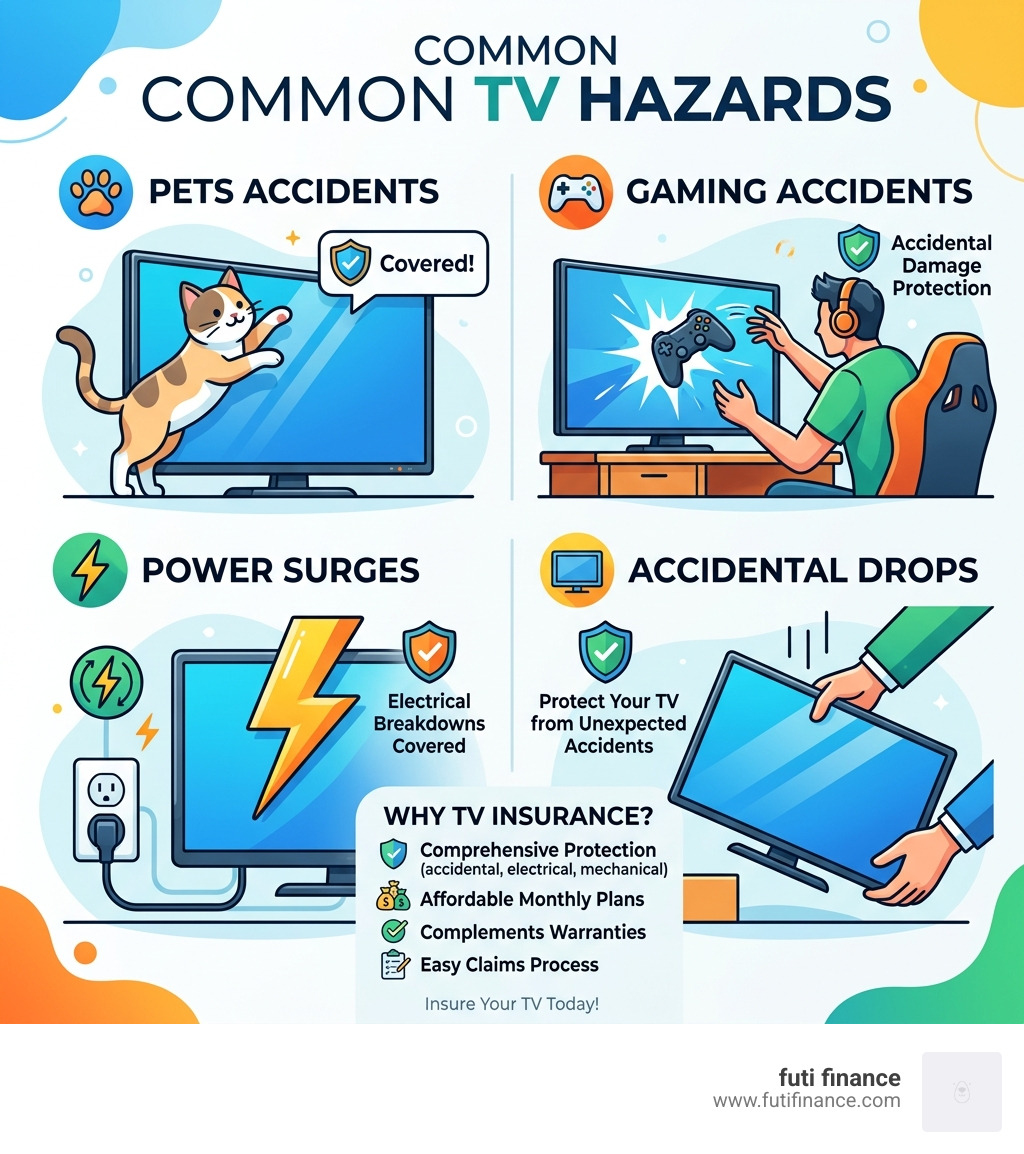
Your TV isn’t something you carry around every day. But that doesn’t mean it’s safe. Kids, pets, gaming sessions, power surges, and even moving day can all turn a working screen into an expensive problem.
The average TV costs $400–$500 to replace. A screen repair alone can run over $1,000. And the manufacturer warranty that came in the box? It typically only covers factory defects — and only for 12 months.
For budget-conscious students and young adults, an unexpected TV breakdown isn’t just annoying. It’s a real financial hit.
That’s exactly why more people are looking into dedicated TV insurance — simple, affordable plans that cover the real-world accidents that warranties and home insurance often miss.
Understanding TV Insurance vs. Manufacturer Warranties
When we talk about protection for your electronics, it is easy to get confused by the jargon. Is it a warranty? Is it a service contract? Is it insurance? While they all sound similar, the differences are huge when you are actually staring at a broken screen.
A manufacturer’s warranty is essentially a promise from the brand (like Samsung, LG, or Sony) that the product was built correctly. It usually covers mechanical failure and electrical breakdowns caused by factory defects. However, these are strictly limited. Most only last 12 months, and some even drop to 90 days for certain components. If your TV simply refuses to turn on because a chip inside failed, the warranty is your friend. But if your cat knocks it over? The manufacturer will politely tell you that isn’t their problem.
TV insurance (or an extended service contract) is much more comprehensive. It picks up where the factory warranty leaves off and, in many cases, runs alongside it to provide extra layers of security. While a warranty is about how the TV was made, insurance is about how the TV is used in your actual home.
Why a standard warranty isn’t enough to insure my tv
Think of a standard warranty as a “fair weather” friend. It’s there as long as nothing unusual happens. But life for a student or a young family is rarely “fair weather.” Here is what a standard warranty typically ignores:
- Accidental Drops: Whether you are moving into a new dorm or just rearranging the living room, one slip can end it all.
- Liquid Spills: A stray soda or a leaky ceiling during a storm isn’t covered by a factory promise.
- Screen Cracks: The most common TV injury. Whether it’s a toy or a rogue gaming controller, warranties don’t cover physical impact.
- Power Surges: In many areas, electrical spikes can fry sensitive internal boards. Most warranties exclude damage from “external power sources.”
- Expired Coverage: Once that first year is up, you are completely on your own.
By choosing to insure my tv, we are looking for protection that accounts for the fact that accidents happen to 67% of American households.
What Does it Mean to Insure My TV?
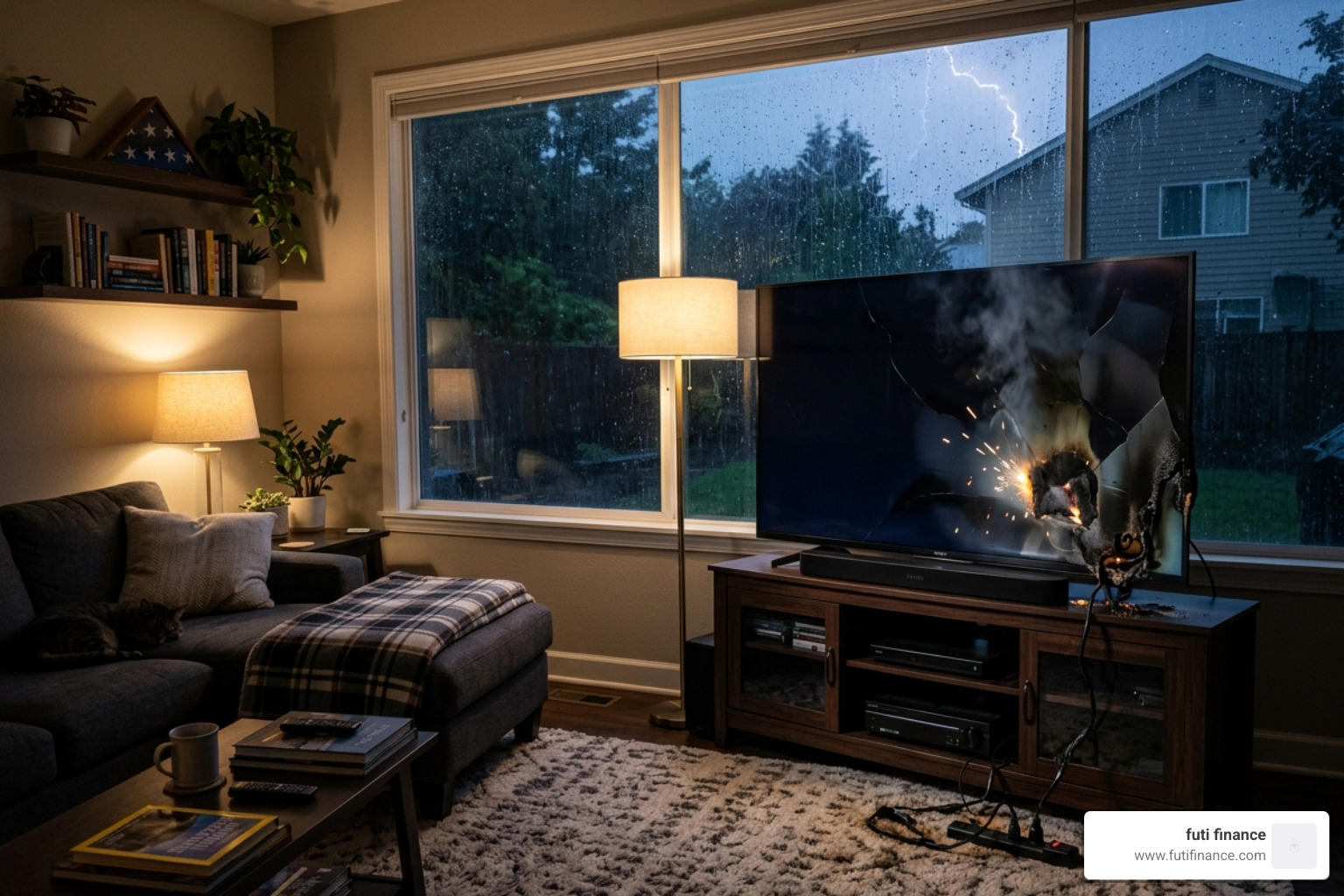
When you decide to insure my tv, you are buying a safety net. This coverage is designed to handle the “unpredictable.” Modern TVs are essentially giant, fragile computers. They rely on complex internal components that are sensitive to heat, humidity, and even dust.
A solid TV insurance policy typically covers:
- Mechanical and Electrical Failure: When the hardware just gives up.
- Power Surge Protection: Coverage for when lightning or a grid spike fries the circuits.
- Screen Burn-in: Especially important for OLED owners, where static images can leave permanent ghosts on the screen.
- Dead Pixels: Most policies will trigger a repair if a certain number of pixels stop working.
- Accidental Damage from Handling (ADH): This is the big one—it covers the drops and spills that happen during normal use.
| Feature | Accidental Damage | Mechanical Breakdown |
|---|---|---|
| Cause | External (drops, spills, impact) | Internal (part failure, defects) |
| Covered by Warranty? | Almost never | Yes (within 12 months) |
| Covered by TV Insurance? | Usually (check your plan) | Yes |
| Typical Cost to Fix | $500 – $1,200 | $200 – $600 |
Common exclusions when I insure my tv
Even the best insurance isn’t a “get out of jail free” card for everything. We need to be realistic about what is usually left out:
- Cosmetic Damage: If there is a small scratch on the plastic frame that doesn’t affect the picture, insurance likely won’t pay for a replacement.
- Intentional Misuse: If you throw a chair at the TV in a fit of rage, that’s on you.
- Pre-existing Faults: You can’t buy insurance for a TV that is already broken.
- Theft: Interestingly, some “protection plans” focus only on repairs. If you want theft coverage, you often need to ensure your plan specifically includes it or rely on a broader gadget policy.
- Commercial Use: If you use the TV for a business or in a public waiting room, standard personal policies won’t apply.
Coverage limits and waiting periods
Before you sign up, always check the “fine print” regarding limits. Most policies have a claim cap—for example, they might pay out up to $2,000 per incident or have a total limit equal to the original price of the TV.
There is also often a waiting period. To prevent people from buying insurance after an accident, some providers have a 30-day or even 90-day window before you can file your first claim. However, if you provide a receipt showing you bought the plan at the same time as the TV, this wait is often waived.
Comparing Protection: Home Insurance vs. Dedicated TV Plans
A common question we hear is: “Doesn’t my renters or homeowners insurance already cover this?”
The answer is: Sort of, but not really.
Standard home insurance is designed for “catastrophes.” It covers your TV if your house burns down, if a pipe bursts and floods the room, or if someone breaks in and steals it. However, it rarely covers “oops” moments. If you trip over the cord and the TV hits the floor, your home insurance probably won’t pay a cent.
Furthermore, home insurance has high deductibles. If your deductible is $500 or $1,000, and your TV cost $600, filing a claim is pointless. Plus, filing a claim on your home insurance can cause your monthly premiums to skyrocket for years to come. Dedicated TV insurance usually has a much lower deductible (sometimes as low as $0 to $50) and won’t affect your other insurance rates.
Single-device vs. multi-appliance protection
For students and young adults living in shared apartments, the math gets interesting. The average U.S. household now contains over $19,000 worth of technology. Between your TV, laptop, gaming console, and smartphone, you’re sitting on a goldmine of fragile glass and circuits.
You have two main choices when looking to insure my tv:
- Single-Device Plans: Best if you only have one high-value item (like a $2,000 OLED TV) that you want to protect with a dedicated policy.
- Multi-Appliance/Whole-Home Plans: These are often the “smart” choice for students. For a flat monthly fee (often around $15–$25), you can cover your TV and 20+ other devices like your laptop, tablet, and speakers. Bundling these together can save you a fortune compared to insuring them individually.
The Cost-Benefit Analysis: Is TV Insurance Worth It?

Is it actually worth the money? Let’s look at the numbers.
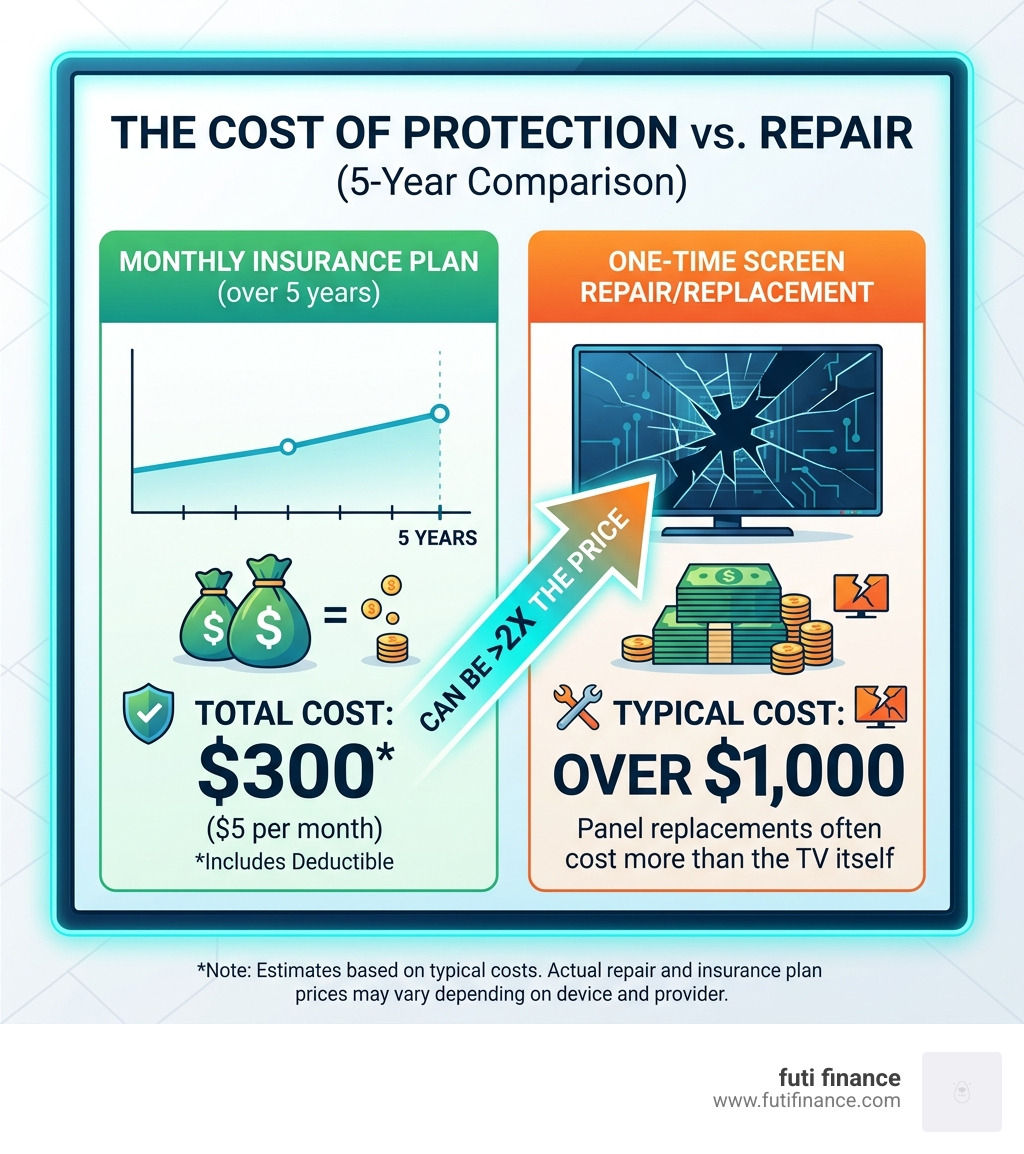
Global television sales top $200 million annually because we love our screens, but we often underestimate the cost of a “simple” fix. Because modern TVs are so slim, they aren’t really designed to be “repaired” in the traditional sense. If the panel (the screen itself) breaks, the cost to replace that single component is often more than $1,000. In many cases, it is cheaper to buy a brand-new TV than to fix a broken screen.
If you pay $5 a month to insure my tv, you are spending $60 a year. If that TV lasts you five years, you’ve spent $300. If the TV cost you $1,200, that $300 is a small price to pay for the peace of mind that a single accidental drop won’t cost you another $1,200.
Factors that influence the cost to insure my tv
Not all TVs cost the same to protect. When we calculate your rate, we look at:
- Purchase Price: A $300 budget TV will be cheaper to insure than a $3,999 home theater setup.
- Screen Size: Larger screens are more expensive to ship and repair, which can bump up the premium.
- TV Brand: Some brands have more expensive proprietary parts, which insurers take into account.
- Deductible: Choosing a higher deductible (the amount you pay out of pocket during a claim) will lower your monthly cost.
- Student Discounts: Since we specialize in insurance for students and young adults, we know that every dollar counts. Many providers offer lower rates or reduced deductibles for those currently in school.
How to File a Claim and Get Back to Your Shows
Nothing is more frustrating than a broken TV on the night of a season finale. If the worst happens, the claims process should be fast. Here is how it usually works:
- Report the Incident: Log into your 24/7 online portal as soon as the damage occurs.
- Provide Documentation: You will usually need your proof of purchase (the receipt) and a few incident photos showing the damage.
- The Diagnosis: The insurer will determine if it can be fixed. They might send a technician to your house (in-home repair) or ask you to take it to a local repair shop.
- Repair or Replace: If it’s fixable, they pay the bill. If it’s not, they will either send you a replacement unit of the same quality or cut you a check for the replacement value.
Eligibility and post-purchase requirements
Can you insure my tv if you didn’t buy the insurance at the checkout counter? Usually, yes!
- The 120-Day Window: Many independent insurers allow you to buy a plan as long as the TV was purchased new within the last 120 days.
- The 4-Year Limit: Some “whole-home” plans will cover any TV in your house as long as it was purchased in the last four years and is currently in good working condition.
- Registration: It is a “best practice” to register your device and upload your receipt to your insurance account before something breaks. This makes the claim process much smoother.
Frequently Asked Questions about TV Insurance
Does TV insurance cover a cracked screen from a Wii remote or toy?
Yes, provided your policy includes Accidental Damage from Handling (ADH). This is specifically designed for impact protection. Whether it’s a gaming accident or a toddler with a heavy toy, this is exactly why people choose to insure my tv.
Can I buy insurance for a TV I bought six months ago?
It depends on the provider. Some specialized “extended warranty” companies require you to sign up within 30 to 120 days of purchase. However, “lifestyle” or “whole-home” protection plans often allow you to add any device you own, provided it isn’t already broken at the time of sign-up.
How long does the TV repair or replacement process take?
Most claims are approved within a few business days once the documentation is submitted. If a repair is needed, it depends on parts availability. Some premium plans even offer 24-hour replacements or same-day service through local repair networks to get you back to your shows as quickly as possible.
Conclusion
At the end of the day, your TV is more than just a piece of plastic and glass—it’s your gateway to movies, gaming, and relaxation. In a busy household or a crowded student apartment, “accidents” aren’t a matter of if, but when.
Choosing to insure my tv isn’t just about protecting a gadget; it’s about protecting your budget and your peace of mind. By opting for a plan that understands the unique needs of young adults—with low deductibles and easy online claims—you ensure that a “game over” in your living room doesn’t mean “game over” for your bank account.
Ready to protect your setup? Protect your tech with Futi Finance and see how smart, affordable insurance can make your life a whole lot easier.
