
Renters Insurance Accidental Damage Explained
What Renters Insurance Actually Covers for Accidental Damage (And What It Doesn’t)
Does renters insurance cover accidental damage? The short answer is: it depends on what was damaged and how.
Here’s a quick breakdown:
| Situation | Covered? |
|---|---|
| Your belongings damaged by fire, smoke, or burst pipe | Yes |
| You accidentally start a fire that damages a neighbor’s unit | Yes (liability) |
| You drop and break your own laptop | Usually no |
| Flood or earthquake damages your stuff | No (without add-ons) |
| Normal wear and tear on your belongings | No |
| You accidentally damage your landlord’s property (fire/smoke) | Sometimes (liability) |
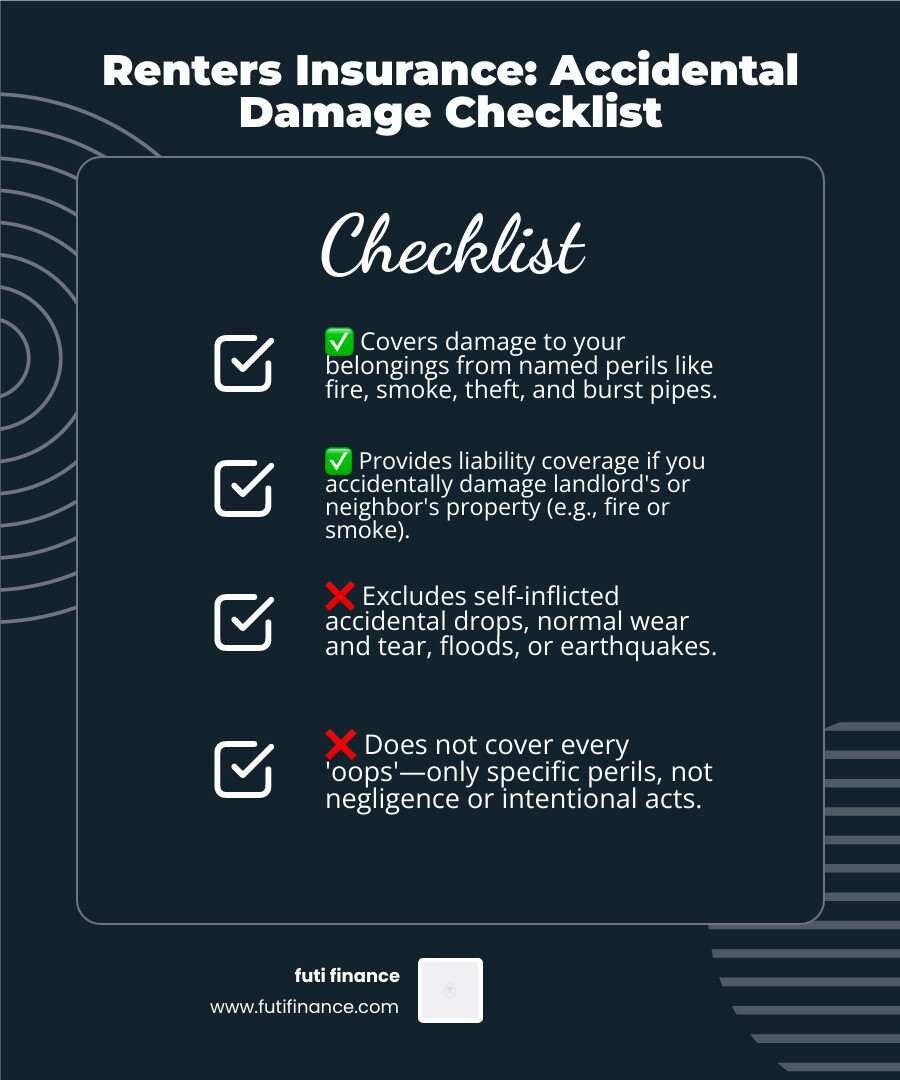
Renters insurance is not a catch-all for every accident. It covers damage caused by specific named perils — think fire, theft, windstorms, and internal water leaks — not every “oops” moment.
For students and young adults, this distinction matters a lot. Your $1,200 laptop isn’t automatically covered just because you accidentally knocked it off a desk. But if a kitchen fire destroyed it? That’s a different story.
The average policy costs just $15–$20 per month, which makes it one of the most affordable financial safety nets available. But only if you understand what you’re actually paying for.
This guide breaks down exactly where coverage kicks in — and where it stops.
Introduction
As we navigate life in April 2026, the rental market is more dynamic than ever. Whether you are a student moving into your first dorm-style apartment or a young professional upgrading to a modern studio, understanding your financial safety net is crucial. Many of us assume that if we pay our rent on time, we are protected. However, tenant responsibilities extend far beyond the monthly check.
Unexpected emergencies—from a burst pipe in the unit above to a kitchen fire sparked by a late-night snack gone wrong—can happen to anyone. Without the right coverage, these “accidents” can lead to financial ruin. Renters insurance isn’t just a line item in your lease agreement; it is a vital tool that protects your bank account when life gets messy.
Understanding the Components of a Standard Policy
Before we dive into the “oops” moments, we need to look at the four pillars of a standard HO-4 policy (that’s insurance-speak for a renters policy).
- Personal Property: This covers your “stuff”—your clothes, electronics, furniture, and that air fryer you use every single day.
- Personal Liability: This is your shield if you are found legally responsible for hurting someone or damaging their property.
- Loss of Use (Additional Living Expenses): If a fire makes your apartment unlivable, this pays for your hotel and extra food costs.
- Medical Payments to Others: This covers minor medical bills if a guest gets hurt in your home, regardless of who is at fault.
To truly grasp What Renters Insurance Covers—and What It Doesn’t, you have to understand the concept of named perils. Most policies only pay out if the damage is caused by a specific list of events, such as fire, lightning, windstorms, theft, or vandalism.
You also need to keep an eye on your policy limits (the maximum the company will pay) and your deductible (the amount you pay out of pocket before insurance kicks in). If you have a $500 deductible and your $400 TV is stolen, the insurance company won’t cut you a check.
Does Renters Insurance Cover Accidental Damage to Your Belongings?

This is where things get tricky. If you’re asking, “does renters insurance cover accidental damage to my own things?” the answer is usually no if the accident was caused by you just being clumsy.
If you spill coffee on your MacBook Pro or drop your smartphone in the toilet, most standard policies will not cover the repair. Why? Because “clumsiness” isn’t one of the 16 named perils. However, if that same laptop is destroyed by a fire or smoke, or if a pipe bursts and denches your tech, you are covered.
According to What Is Covered by Renters’ Insurance?, insurance is designed to cover sudden and accidental events that are outside of your control, like theft or vandalism.
Actual Cash Value vs. Replacement Cost Value
When you file a claim for your belongings, how much you get back depends on your policy type. We always recommend checking which one you have:
| Feature | Actual Cash Value (ACV) | Replacement Cost Value (RCV) |
|---|---|---|
| Calculation | Current value (minus depreciation) | Cost to buy the item brand new today |
| Payout Example | Your 5-year-old couch might get you $150 | You get enough to buy the same couch new ($800) |
| Premium Cost | Lower | Usually about 10% higher |
| Our Advice | Avoid if possible | The gold standard for young adults |
Liability Coverage and Damage to the Landlord’s Property
While your policy might not buy you a new phone if you drop it, it is a lifesaver if you accidentally damage the building itself. This falls under Personal Liability.
Most landlords require a minimum of $100,000 in liability coverage, and for good reason. If you accidentally start a kitchen fire that damages the cabinets, the walls, and the neighbor’s unit, you could be on the hook for tens of thousands of dollars. In fact, research shows tenant damage claims can range from $5,000 to $30,000, and sometimes much more depending on the location.
What Renters Insurance Does and Does Not Cover | Bankrate notes that liability coverage also pays for your legal defense fees if you are sued over an accident. It also covers guest medical expenses. If a friend trips over your rug and needs an X-ray, your policy can cover those costs (usually up to $5,000) without anyone having to file a lawsuit.
Key Exclusions: When Accidental Damage Is Not Covered

Even the best insurance has limits. We want you to avoid the “claim denied” heartbreak by knowing these common exclusions:
- Normal Wear and Tear: That stain on the carpet that’s been growing for three years? The scratches on the hardwood from your desk chair? Insurance won’t pay for those. That is what your security deposit is for.
- Negligence: If you leave your window wide open during a rainstorm and your carpet gets soaked, the insurer might deny the claim because the damage was preventable.
- Intentional Acts: If you punch a hole in the wall because you’re mad, or intentionally break a window, insurance will not cover it. These are “moral hazards” that insurers avoid.
- Pest Infestations: Damage from bedbugs, mice, or cockroaches is almost never covered. In most states, pest control is considered a maintenance issue for the landlord.
- Floods and Earthquakes: Standard policies exclude “acts of God” like floods and earthquakes. If you live in a high-risk area, you need a separate policy or an endorsement.
- Roommate Belongings: Unless your roommate is specifically named on your policy, their stuff is not protected. We always suggest that every roommate gets their own individual policy to avoid confusion.
How to Ensure You Have Adequate Coverage in 2026
In 2026, being a “smart renter” means more than just paying rent on time. It means being prepared. Here is our step-by-step guide to making sure you are fully protected:
- Create a Home Inventory: Walk through your apartment and take a video of everything you own. Open closets and drawers. This photo documentation is your best friend during a claim.
- Use Tech to Your Advantage: Use home inventory apps to store receipts and serial numbers.
- Consider Riders and Endorsements: If you have high-value items like a $3,000 engagement ring or a professional gaming rig, a standard policy might limit your payout to $1,500. You can add “scheduled personal property” coverage to protect these items for their full value.
- Add Water Backup Coverage: This is an optional add-on that covers damage if a sewer or drain backs up—something that isn’t always included in the “burst pipe” category.
- Review Annually: Our lives change fast. Did you buy a new e-bike? Did you get a dog? What Does Renters Insurance Cover & How Does It Work? emphasizes that an annual policy review ensures your limits still match your lifestyle.
- Choose the Right Deductible: A higher deductible (like $1,000) will lower your monthly premium, but make sure you actually have $1,000 in savings in case something goes wrong.
Frequently Asked Questions about Coverage Limits
Does renters insurance cover accidental damage during a move?
Moving is the ultimate test of your patience and your furniture’s structural integrity. Generally, your renters insurance covers your items “in transit” against the same named perils (like fire or theft from the moving truck). However, it usually does not cover damage caused by the movers dropping your TV. For that, you need to ensure your moving company has its own liability insurance or purchase a specific transit endorsement.
Does renters insurance cover accidental damage caused by pets?
We love our furry friends, but they can be destructive.
- Damage to others: If your dog bites a neighbor or trips a guest, your pet liability coverage usually kicks in to pay for medical bills and legal fees.
- Damage to your stuff: If your cat uses your expensive sofa as a scratching post, your insurance will not cover it.
- Damage to the rental: Most policies won’t cover a dog chewing through the baseboards of your apartment. However, some specialized pet damage endorsements are becoming available in 2026—it’s worth asking us about!
What is the difference between accidental and negligent damage?
This is a fine line that insurance adjusters walk every day.
- Accidental: You are cooking dinner, the phone rings, you get distracted for a second, and a grease fire starts. This is a sudden, unintended event. It’s covered.
- Negligent: you know the bathtub drain is slow, but you leave the water running to take a phone call in the other room. The tub overflows and ruins the floor. Because you knew about the risk and failed to act, an insurer might label this as negligence and deny the claim.
Conclusion
At Futi Finance, we believe that being a student or a young adult shouldn’t mean living in financial fear. Accidents are a part of life, but they don’t have to be the end of your savings. By understanding that does renters insurance cover accidental damage primarily when it involves named perils or liability, you can make smarter decisions about your coverage.
We specialize in providing affordable, intelligent insurance solutions tailored specifically for your lifestyle. Don’t wait for a “burst pipe” Tuesday to realize you’re underinsured. Protect your future and your belongings with a policy that actually makes sense for you.
